⚡ Quick Bites (TL;DR) – Pro Tip: Always integrate your corporate email ID or university credentials with your Amazon or Flipkart accounts at least a week before the sale. Verified corporate and student accounts unlock hidden 5% to 7% base discounts that stack perfectly with credit card subventions.
⚡ Quick Bites (TL;DR) – Strategic Warning: Extended 12-to-18-month No-Cost EMI plans heavily block your credit limit. If you purchase a laptop worth ₹1,20,000, your bank will block the entire amount on your card, reducing your available credit and temporarily increasing your credit utilization ratio.
⚡ Quick Bites (TL;DR) – Critical Alert: Beware of third-party sellers offering unusually massive discounts on current-generation hardware without official brand warranty tags. Unverified sellers often offload refurbished or gray-market units that are ineligible for extended brand protection and domestic EMI claims.
The acquisition of high-performance computing hardware represents one of the most substantial consumer investments outside of vehicular and real estate sectors. As the Indian digital workforce expands and the demand for premium content creation and gaming rigs accelerates, the September and October mega-sales serve as the ultimate fiscal battleground. E-commerce titans deploy their most sophisticated pricing algorithms during this window, turning high-ticket computing acquisitions into an exercise in strategic financial planning. To secure the absolute lowest acquisition cost, consumers must look beyond front-page banners and master the underlying mechanics of institutional banking partnerships, corporate price subventions, and algorithmic inventory clearances.
Unlike mobile devices, which see frequent iterative releases throughout the year, the lifecycle of a premium laptop or desktop processor is longer, meaning the margins for aggressive price slashing are significantly higher during clearance cycles. Hardware manufacturers aggressively incentivize the clearing of previous-generation silicon (such as Intel’s older core architectures or Apple’s previous M-series chips) to pave the way for holiday releases. When these aggressive brand clearances collide with tier-one banking promotions, the resulting financial structures offer unparalleled value for consumers who understand how to navigate Indian Festive Tech Deals with clinical precision.
Demystifying Laptop Pricing and Bank Subventions
To accurately capture the Best Laptop Discounts in the market, one must deconstruct the financial anatomy of a high-ticket checkout. A premium ultrabook listed at an MRP of one lakh twenty thousand rupees might be advertised at an effective rate of eighty-five thousand rupees. This dramatic reduction is synthesized through multiple, distinct financial levers that must be activated sequentially by the buyer.
The foundation of the reduction is the flat platform discount. E-commerce platforms subsidize the base cost to drive gross merchandise value (GMV). However, the critical layer of savings is the instant bank discount. Financial institutions like HDFC, ICICI, and SBI allocate vast marketing budgets to dominate the digital checkout space. Because laptops command higher average order values than standard electronics, banks frequently raise the maximum discount cap specifically for the computing category. While a standard smartphone purchase might max out at a three thousand rupee instant discount, premium laptops frequently unlock specialized high-value bins offering five thousand to ten thousand rupees in instant statement credits. Deploying the correct premium credit card variant is absolutely essential to unlocking these upper-tier subvention limits.
This instant bank deduction operates synergistically with the platform’s No-Cost EMI framework. Unlike traditional term loans where interest accumulates over time, the No-Cost EMI structure forces the merchant to absorb the bank’s projected interest load as an upfront invoice reduction. For a high-ticket laptop, this interest subvention can easily equate to eight to twelve thousand rupees in immediate savings. This mechanism empowers buyers to maintain maximum liquidity, preserving their cash reserves while securing top-tier computational hardware.
Exploiting Corporate and Student Discount Portals
A highly lucrative, yet frequently overlooked, dimension of high-value tech financing is the utilization of institutional pricing structures. Leading e-commerce platforms and direct-to-consumer brand websites (such as Lenovo India, HP, and Apple) operate segregated pricing databases for verified corporate employees and active university students. This demographic is highly coveted by hardware manufacturers due to their lifetime value and brand loyalty.
By verifying an active ‘.edu’ email address or a corporate credential via platforms like UNiDAYS or Amazon Business, consumers can bypass the standard retail pricing algorithm entirely. This verification unlocks a baseline reduction of five to ten percent that is strictly hidden from the general public. The true financial mastery occurs when this hidden institutional discount is stacked with a premium credit card offer. Because the institutional discount lowers the base price before the banking gateway is reached, the consumer pays significantly less upfront GST and reduces the overall principal amount that requires financing.
💎 Mizanur’s Smart Financing Hack
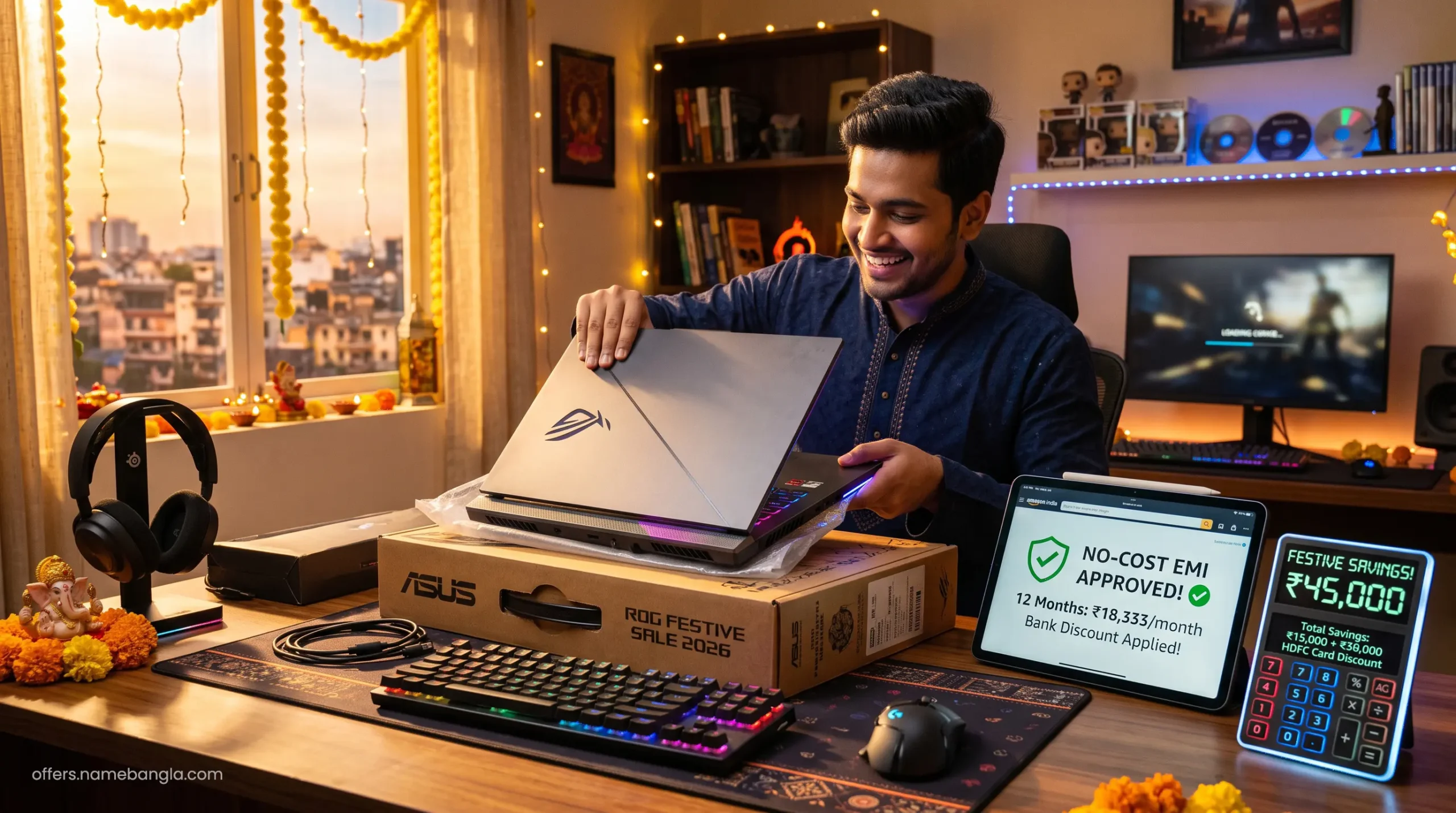
To dominate high-end computing acquisitions, execute the “Corporate EMI Arbitrage” method. Do not use your standard consumer account. Instead, log into the e-commerce platform using your verified corporate or GST-registered business account. This immediately strips away standard retail markups and allows you to claim Input Tax Credit (ITC) if applicable. Next, apply a high-tier exchange offer for an old, depreciated laptop (the platform often adds a flat ₹5,000 exchange bonus during mega sales). Finally, execute the payment using an SBI Cashback or HDFC Diners Club credit card on a 9-month No-Cost EMI tenure. The combination of the corporate base rate, the inflated exchange bonus, and the merchant-absorbed interest subvention will drive the net acquisition cost down by nearly forty percent of the original retail price.
The Mechanics of Laptop Exchange Bonuses
Upgrading a personal computer is fundamentally different from upgrading a smartphone. Legacy laptops, even those that are five to seven years old, retain significant internal component value, particularly regarding RAM modules, functional displays, and chassis materials. E-commerce algorithms recognize this residual value and deploy aggressive trade-in bonuses to incentivize hardware upgrades during the September and October retail windows.
During these peak events, platforms introduce artificial valuation bumps known as “Extra Exchange Bonuses.” An obsolete dual-core laptop that might fetch a mere two thousand rupees in a local secondary market could be algorithmically valued at eight thousand rupees when traded in against a premium gaming rig or a high-end ultrabook. To ensure this valuation holds up during the doorstep diagnostic evaluation, consumers must prepare the legacy hardware meticulously. The device must boot up to the operating system successfully, the display hinge must be structurally sound, and the original power adapter must be surrendered. Failing the physical checklist will instantly void the algorithmic bonus, forcing the buyer to cover the valuation gap out of pocket.
Much like the strategies deployed for Premium Smartphone Offers, executing a successful laptop exchange requires pristine physical preparation. Erase all localized data partitions, ensure the battery holds at least a fifteen-minute charge independent of the wall adapter, and clean the external chassis to maximize the delivery executive’s visual assessment.
Navigating Extended Tenure Credit Card EMIs
The sheer capital required for high-performance computing necessitates flexible capital distribution models. While smartphones are typically capped at six to nine-month subvention cycles, premium laptops and desktop workstations frequently qualify for extended No-Cost EMI tenures stretching from twelve to eighteen months. This elongated repayment architecture is primarily facilitated by premium credit card networks and specialized consumer durable non-banking financial companies (NBFCs) like Bajaj Finserv.
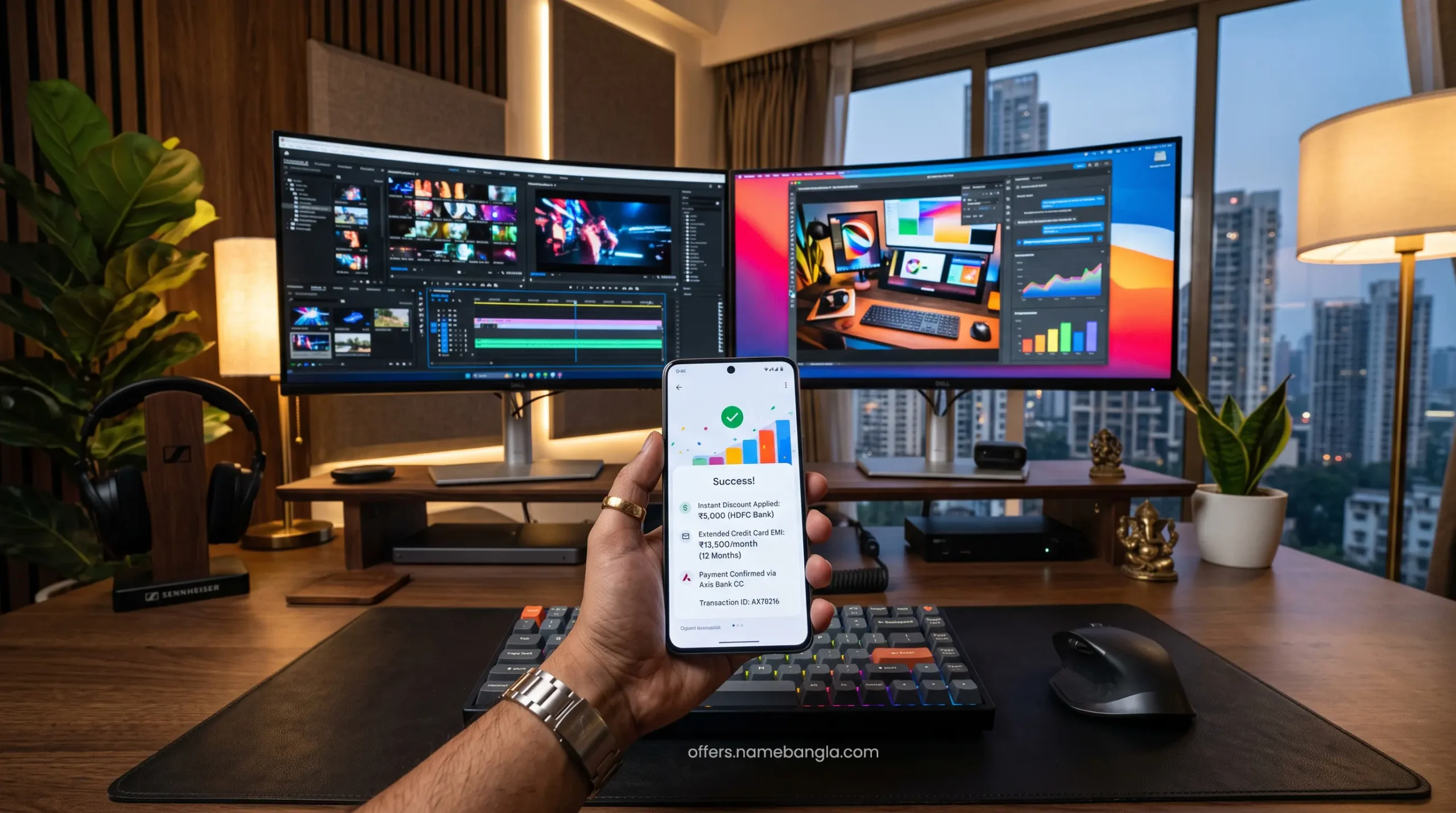
Stretching the capital expenditure over eighteen months dramatically lowers the monthly installment burden, allowing digital professionals to acquire superior computational power without straining their immediate operational liquidity. A superior machine enhances rendering speeds, code compilation, and workflow efficiency, effectively paying for itself over the extended tenure. However, consumers must exercise hyper-vigilance regarding their credit utilization. When you authorize a high-ticket eighteen-month EMI, the issuing bank instantly blocks the entire principal amount from your available credit limit, slowly releasing it back as you clear each monthly installment.
If purchasing a high-end workstation consumes more than fifty percent of your total available credit limit, it can temporarily depress your CIBIL score due to high credit utilization metrics. To counter this, savvy consumers proactively request limit enhancements across their primary banking relationships several weeks prior to the festive season. By expanding the total available credit pool, the utilization ratio remains below the critical thirty percent threshold, securing your creditworthiness while you leverage advanced Smart Gadget Financing techniques to dominate the digital retail landscape.
Frequently Asked Questions on Premium Laptop Financing
How does a corporate discount impact a No-Cost EMI laptop purchase?
A corporate or student discount lowers the base invoice price of the laptop before the payment gateway is reached. When you subsequently apply a No-Cost EMI, the bank calculates the interest (which the merchant absorbs) on this lower principal amount, resulting in a substantially reduced final checkout price.
Why does my bank block my entire credit limit for an EMI transaction?
When you authorize a credit card EMI, the bank is issuing an unsecured loan for the full purchase amount. To secure this debt, they block the equivalent amount on your available credit limit, gradually restoring it month by month as you pay off the principal installments.
What are the physical requirements to get the maximum laptop exchange bonus?
To secure the maximum algorithmic exchange value, your old laptop must successfully boot to the operating system, possess a physically intact display without dead pixels, have functioning hinges, and be handed over with the original, working power adapter.
Do all credit cards offer 12 to 18-month No-Cost EMI on laptops?
No. Extended 12 to 18-month No-Cost EMI tenures are typically restricted to high-value purchases (usually above ₹50,000) and are often exclusive to premium credit card variants from major banks like HDFC, ICICI, and SBI, or specialized NBFCs like Bajaj Finserv.
Can I claim GST Input Tax Credit (ITC) while using a consumer credit card for an EMI?
Yes, if you purchase through a verified business portal (like Amazon Business) using your GST number. However, the EMI interest GST charged directly by your bank on your credit card statement cannot typically be claimed as ITC against the hardware purchase; only the base hardware GST can be claimed.