⚡ Quick Bites (TL;DR) – Pro Tip: Large appliances like 65-inch OLED televisions frequently feature bundled soundbars or extended 3-year comprehensive warranties during festive sales. Always check the “Combo Offers” section before checkout, as these high-value additions are often free but require manual selection.
⚡ Quick Bites (TL;DR) – Strategic Warning: When trading in your old television for an exchange bonus, ensure the screen has absolutely no physical cracks or dead pixel lines. The delivery executive will perform a rigorous power-on test; a failed screen test instantly invalidates the massive festive exchange discount.
⚡ Quick Bites (TL;DR) – Critical Alert: Non-banking financial consumer durable loans (like Bajaj Finserv) offer zero down payments, but missing a single electronic clearing service (ECS) mandate triggers severe bounce penalties from both your bank and the NBFC, rapidly negating any discount you acquired.
The transition from standard high-definition displays to ultra-premium 4K, OLED, and QLED panels accelerates exponentially during the Indian festive season. For millions of households, the period spanning September and October represents the optimal window to overhaul their core home entertainment infrastructure. As global sporting events and high-budget cinematic streaming releases demand superior visual fidelity, e-commerce giants like Amazon and Flipkart recognize that large-screen televisions act as massive gross merchandise value (GMV) drivers. However, acquiring a premium sixty-five or seventy-five-inch panel is a significant capital expenditure. To mitigate consumer hesitation, retail algorithms and banking institutions deploy highly complex, multi-layered financial subventions. By thoroughly decoding these pricing structures, buyers can secure flagship viewing experiences while strictly maintaining their monthly financial liquidity.
Unlike portable electronics, the purchase of a large home appliance introduces logistical complexities—specifically regarding the disposal of obsolete hardware and the physical installation of the new unit. To solve this, digital storefronts integrate aggressive trade-in algorithms and bundled service contracts directly into the checkout pipeline. Mastering these embedded discounts is precisely what separates an average shopper from a strategic digital consumer. To extract the highest possible value, one must execute a synchronized utilization of Indian Festive Tech Deals, exploiting every available banking promotion and artificial exchange inflation offered during the mega-sale hours.
Decoding Algorithmic TV Exchange Bonuses
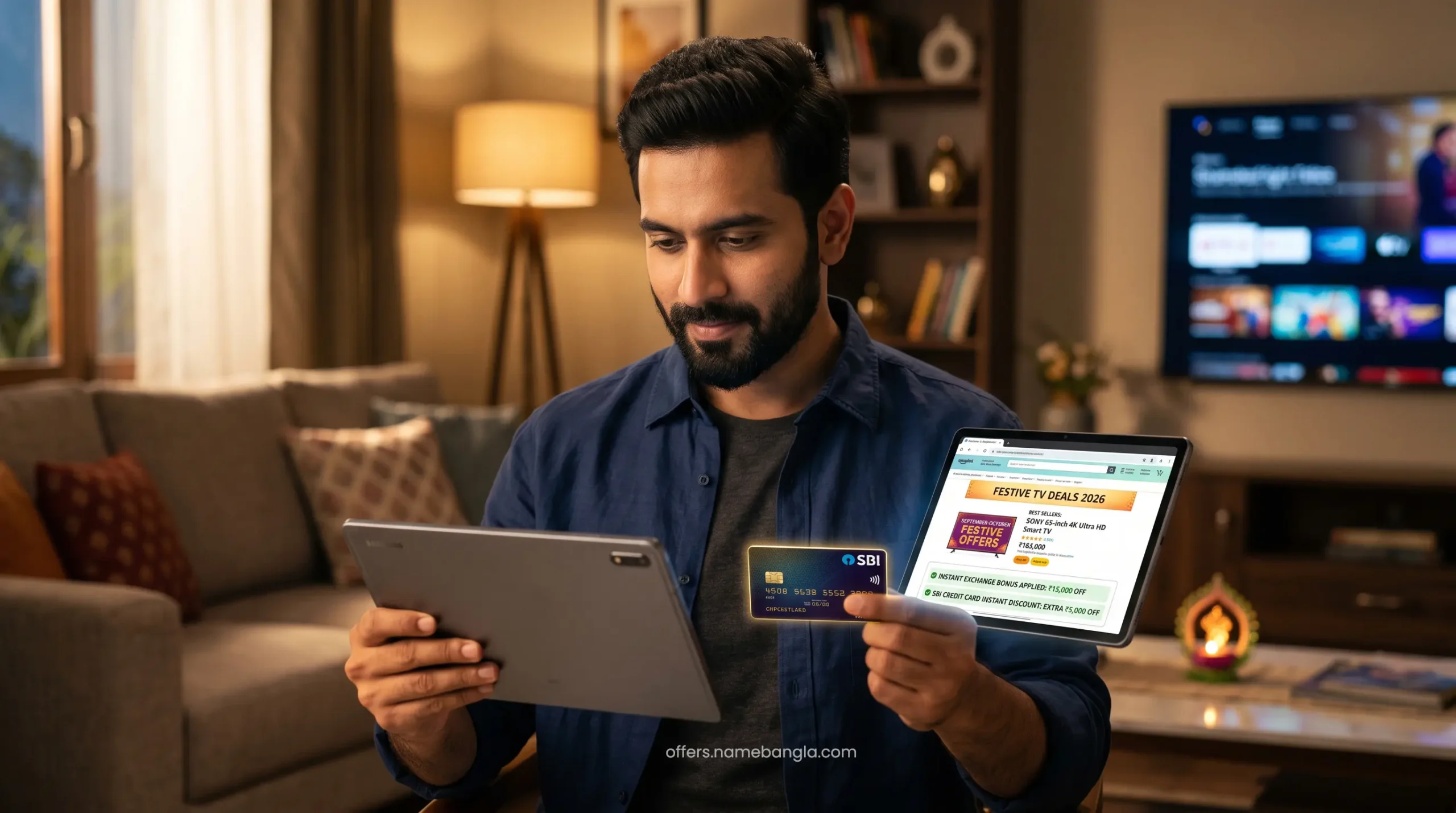
The most immediate and substantial price reduction available to consumers upgrading their living room displays is the algorithmic exchange bonus. In standard retail environments, disposing of a heavy, outdated CRT or an early-generation LCD television is a logistical burden that yields almost zero financial return. However, during the festive retail windows, e-commerce platforms actively subsidize the collection of electronic waste to drive the adoption of modern, high-margin smart panels.
To incentivize the upgrade cycle, platforms artificially inflate the residual value of legacy hardware. An obsolete thirty-two-inch LED TV that holds a secondary market value of perhaps one thousand rupees can suddenly generate a flat “Extra Exchange Bonus” of four to six thousand rupees when traded against a premium 4K television. This aggressive valuation strategy effectively slashes the base invoice price before any banking instruments are even applied. To secure the Smart TV Upgrade Offers smoothly, consumers must understand the rigorous physical evaluation process conducted at their doorstep.
The logistical delivery executive acts as the final arbiter of your algorithmic discount. The legacy television must successfully connect to a power source, boot up, and display an active image without severe discoloration, massive dead pixel clusters, or deep physical cracks on the glass. Remote controls and original stands are generally optional, but the panel integrity is non-negotiable. Should the device fail this visual and operational diagnostic, the exchange bonus is immediately revoked via the delivery executive’s specialized mobile application, and the buyer is forced to pay the valuation difference through an instant digital payment gateway before the new unit is released from the delivery truck.
Leveraging Bajaj Finserv and Consumer Durable Loans
While premium credit cards dominate the high-end smartphone and computing sectors, the large home appliance market heavily relies on specialized non-banking financial companies (NBFCs). Institutions such as Bajaj Finserv have revolutionized the acquisition of consumer durables in India by issuing dedicated EMI network cards that bypass the traditional stringent credit scoring models of major private banks.
These specialized financial instruments are engineered specifically to remove the psychological barrier of large upfront payments. During festive mega-sales, NBFCs roll out highly attractive “Zero Down Payment” and “No-Cost EMI” schemes specifically tailored for smart televisions and home theater audio systems. This allows a consumer to acquire a premium OLED panel by simply agreeing to a fixed electronic clearing mandate divided over eight, ten, or twelve months, with zero immediate cash outflow at the digital checkout portal. For consumers without high-limit traditional credit cards, this is the most effective Smart Gadget Financing pathway available.
However, engaging with consumer durable financing requires meticulous financial discipline. While the interest component is absorbed by the merchant (making it a true No-Cost EMI), NBFCs operate on strict penalty structures. Failing to maintain adequate balance in your linked savings account on the designated EMI deduction date results in immediate and severe financial repercussions. You will incur a bounce charge from your primary banking institution, an additional late payment penalty from the NBFC, and a significant negative remark on your CIBIL credit report. Understanding these risk factors is crucial before committing to a multi-month appliance loan.
💎 Mizanur’s Smart Financing Hack
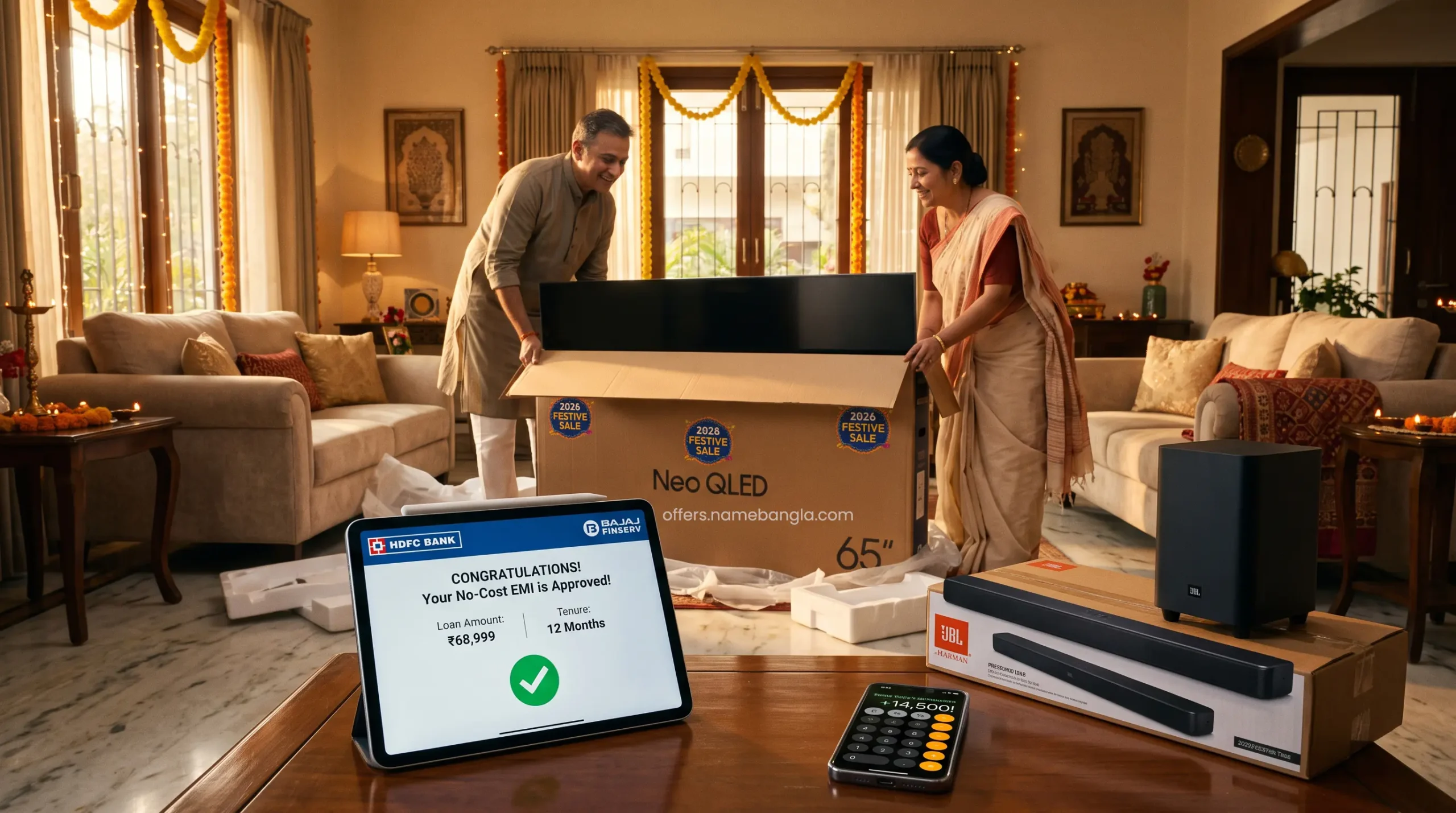
To execute the ultimate living room upgrade, employ the “Dual-Subvention TV Strategy.” First, identify a premium 4K television during the peak sale hours that offers an artificial ‘Extra Exchange Bonus’—trade in your oldest functional LCD to instantly knock ₹5,000 to ₹7,000 off the base price. Crucially, before proceeding to payment, manually add the brand’s promotional bundled soundbar (which is often discounted by 90% when bought together). Finally, execute the checkout using an HDFC or SBI premium credit card on a 9-month No-Cost EMI. Because the TV and soundbar are billed together, the 10% instant bank discount applies to the total cart value. You benefit from the massive exchange inflation, the bundled audio system, and the upfront merchant interest subvention—lowering your total cost of ownership by nearly forty-five percent.
Maximizing Credit Card Statement Credits on Large Appliances
For consumers possessing high-tier banking relationships, utilizing premium credit cards remains the most financially rewarding method for purchasing large displays. E-commerce algorithms frequently configure their instant discount logic differently for large appliances compared to mobile devices. While a smartphone might cap out at a three thousand rupee discount, the appliance category often features elevated discount thresholds, allowing buyers to secure five thousand to eight thousand rupees in instant statement credits using HDFC, SBI, or ICICI cards.
The mechanics of the No-Cost EMI via traditional credit cards are particularly advantageous here. When you authorize a transaction for a one-lakh rupee QLED television over a twelve-month tenure, the platform forces the brand to absorb the projected bank interest as a massive upfront discount. This drops your principal invoice value significantly. Unlike NBFC loans, traditional credit cards offer the flexibility of loan pre-closure. Astute buyers frequently activate the No-Cost EMI to secure the massive upfront merchant discount, wait for the transaction to post to their credit ledger, and immediately contact customer support to pre-close the debt. By absorbing a nominal three percent foreclosure fee, they permanently retain the massive interest subvention discount, achieving a net price far below standard retail structures.
Total Cost of Ownership and Installation Subventions
When finalizing a high-end television purchase, sophisticated buyers must evaluate the Total Cost of Ownership (TCO), which extends beyond the initial hardware invoice. Modern smart panels are highly complex, fragile electronic ecosystems. Consequently, securing extended comprehensive warranties and premium installation hardware is a mandatory consideration. During standard operational periods, a three-year extended brand warranty and a heavy-duty swivel wall mount can add ten to fifteen thousand rupees to your overall expenditure.
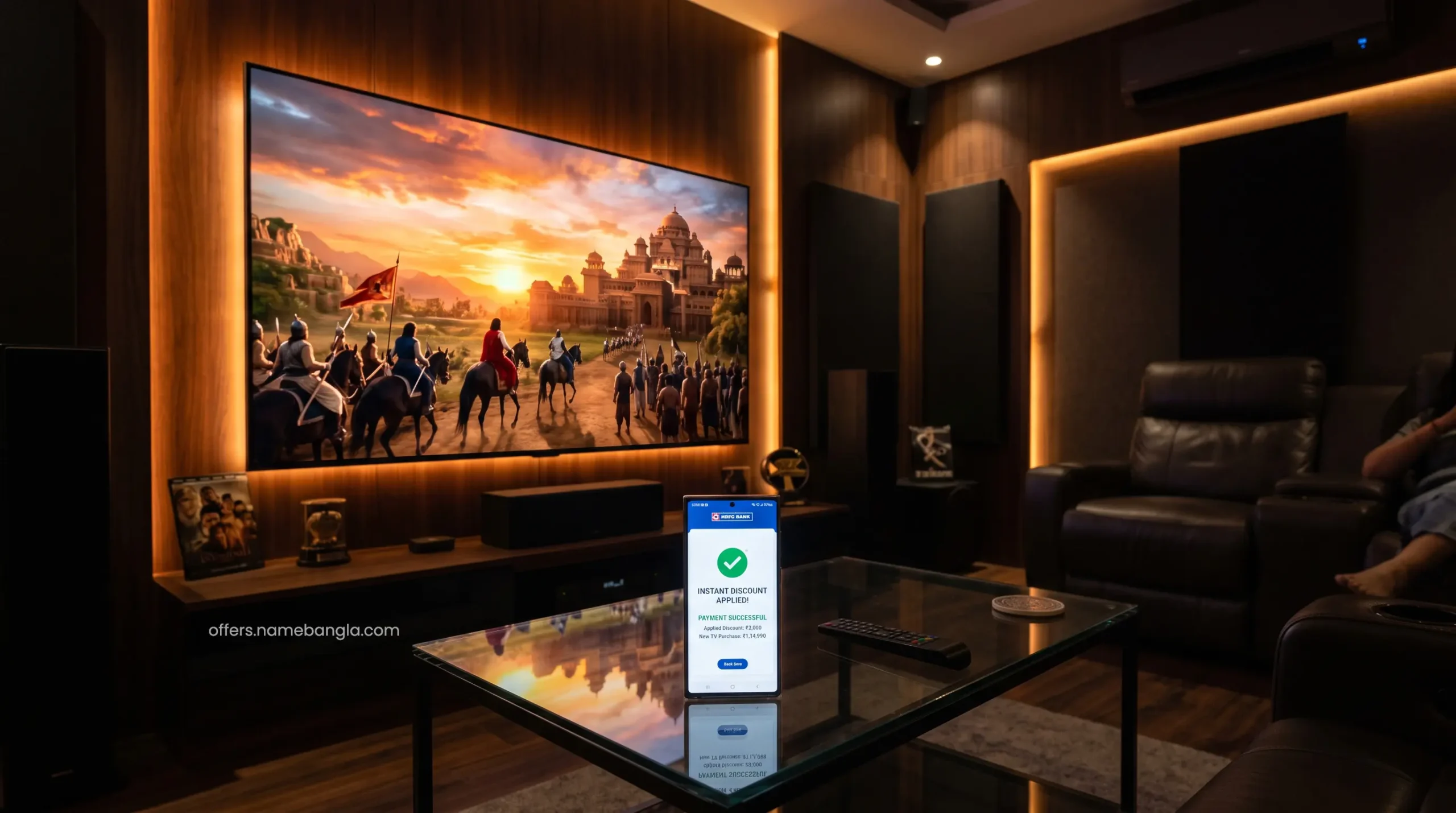
However, during the aggressive September and October promotional cycles, premium brands frequently subsidize these ancillary costs to prevent cart abandonment. Manufacturers like Samsung, LG, and Sony routinely bundle free professional wall-mount installations and zero-cost extended panel warranties exclusively for purchases made during the mega-sale window. It is imperative that consumers meticulously verify that these bundled services are explicitly mentioned on the final digital invoice before authorizing the credit card transaction. By integrating these zero-cost service additions with aggressive exchange bonuses and optimized banking subventions, Indian consumers can achieve a truly cinematic home upgrade while demonstrating absolute financial mastery over the digital retail landscape.
Frequently Asked Questions on Smart TV Financing
How strictly do delivery executives check old TVs during a festive exchange?
The evaluation is strictly functional. The old television must successfully power on and display an active picture without major dead pixels, deep cracks on the display panel, or severe color distortion. If it fails this power-on test, the exchange bonus is instantly revoked.
Does using a Bajaj Finserv EMI card require a down payment for Smart TVs?
During major festive sales, NBFCs like Bajaj Finserv frequently waive the standard down payment requirement, allowing consumers to acquire premium Smart TVs with zero upfront cash, spreading the total cost equally over the chosen monthly tenure.
Can I claim an instant bank discount and a No-Cost EMI simultaneously on a TV?
Yes. Most e-commerce platforms allow ‘stacking’ on large appliances. You can receive the 10% instant discount (up to the maximum bank cap) on the cart value, and then the remaining balance is converted into a No-Cost EMI, generating a further upfront interest subvention discount.
What happens if my bank account lacks funds on the EMI deduction date?
If an Electronic Clearing Service (ECS) mandate bounces due to insufficient funds, your primary bank will charge a bounce fee, the financing institution (like Bajaj Finserv) will apply a severe late penalty, and your CIBIL credit score will be negatively impacted.
Are wall-mounts and installation free during festive online TV purchases?
Yes, for premium brands (like LG, Samsung, Sony), the brand provides free standard wall-mount brackets and professional doorstep installation. You must schedule the installation via the brand’s official customer support after the television is delivered.