⚡ Quick Bites (TL;DR) – Pro Tip: Before targeting flagship mobile deals, ensure your HDFC or SBI credit card has international transactions and online e-commerce limits fully enabled through your mobile banking application to prevent sudden transaction declines during midnight flash sales.
⚡ Quick Bites (TL;DR) – Strategic Warning: Instant bank discounts are heavily bin-specific. A corporate credit card or a basic debit card might not qualify for the maximum ₹5,000 instant discount reserved exclusively for premium retail credit card variants.
⚡ Quick Bites (TL;DR) – Critical Alert: High-value exchange bonuses are strictly conditional. If the delivery executive detects screen burn-in, deep structural dents, or a mismatched IMEI number, the algorithmic exchange discount will be instantly revoked at your doorstep.
The highly anticipated September and October retail windows trigger the most aggressive pricing strategies in the Indian consumer electronics sector. As platforms like Amazon and Flipkart initiate their massive annual campaigns, the sheer volume of mobile device upgrades reaches unprecedented levels. For the discerning consumer, acquiring a flagship mobile device is no longer an exercise in paying full retail price; it is a meticulously calculated financial operation. By understanding the intricate layers of pricing algorithms, consumers can unlock massive reductions on top-tier hardware, transforming a luxury purchase into a highly optimized financial decision. The secret lies in mastering the deployment of banking instruments, specifically targeting high-yield subvention structures and strategic trade-in programs.
The modern digital storefront is powered by real-time bidding algorithms that adjust prices based on inventory velocity and competitive pressures. However, the most substantial price drops do not originate solely from the manufacturer. They are the result of tripartite agreements involving the original equipment manufacturer, the digital marketplace, and leading financial institutions. When these three entities collaborate to push high inventory volumes, the resulting financial structures offer unparalleled acquisition opportunities for consumers who understand how to navigate Indian Festive Tech Deals with precision.

The Anatomy of a Flagship Price Drop
To accurately evaluate the validity of a mobile discount, one must deconstruct the final checkout price into its core components. During mega-sales, a smartphone originally priced at eighty thousand rupees may be advertised at an effective price of fifty thousand rupees. This drastic reduction is rarely a flat discount. It is typically a composite reduction engineered through three distinct financial levers: the base platform discount, the instant bank credit, and the algorithmic exchange bonus.
The base platform discount is the manufacturer’s official price drop, implemented to clear existing warehousing logistics ahead of new product launches. This is the baseline price available to all consumers regardless of their payment method. However, stopping at the base discount leaves substantial money on the table. The secondary layer involves deploying specific financial instruments to trigger instant bank discounts. Financial powerhouses allocate massive marketing budgets to incentivize card usage during these weeks. When a consumer inputs an eligible sixteen-digit card number at the checkout gateway, the system pings the bank’s BIN database, instantly deducting an additional three to five thousand rupees from the total cart value.
This instant deduction is vastly superior to traditional cashback programs. Traditional cashback requires the consumer to pay the higher amount upfront, utilizing a larger portion of their available credit limit, and waiting up to ninety days for the funds to reflect on their statement. Instant discounts immediately lower your credit utilization, protecting your overall CIBIL score while ensuring immediate liquid savings. By leveraging these optimized Smart Gadget Financing routes, buyers maintain absolute control over their monthly capital distribution.
Maximizing HDFC, SBI, and ICICI Credit Card EMI
The cornerstone of premium mobile acquisition during the festive weeks is the No-Cost EMI framework. While it is marketed as an interest-free payment distribution, sophisticated buyers understand that it is actually an upfront interest subvention mechanism. When you opt for a six or nine-month No-Cost EMI on a flagship smartphone using an HDFC, SBI, or ICICI credit card, the issuing bank technically charges a standard consumer loan interest rate, typically hovering around fifteen percent annualized.
To neutralize this cost for the consumer, the e-commerce platform forces a direct reduction on the principal invoice amount equivalent to the projected interest total. For example, if the projected interest over a nine-month tenure is four thousand rupees, the platform will reduce the smartphone’s billing price by exactly four thousand rupees. This is a critical mathematical advantage. The consumer is effectively purchasing the hardware at a heavily subsidized base rate. While the bank will apply an eighteen percent GST strictly on the monthly interest fraction, the overall net acquisition cost remains drastically lower than a standard debit card transaction.
💎 Mizanur’s Smart Financing Hack
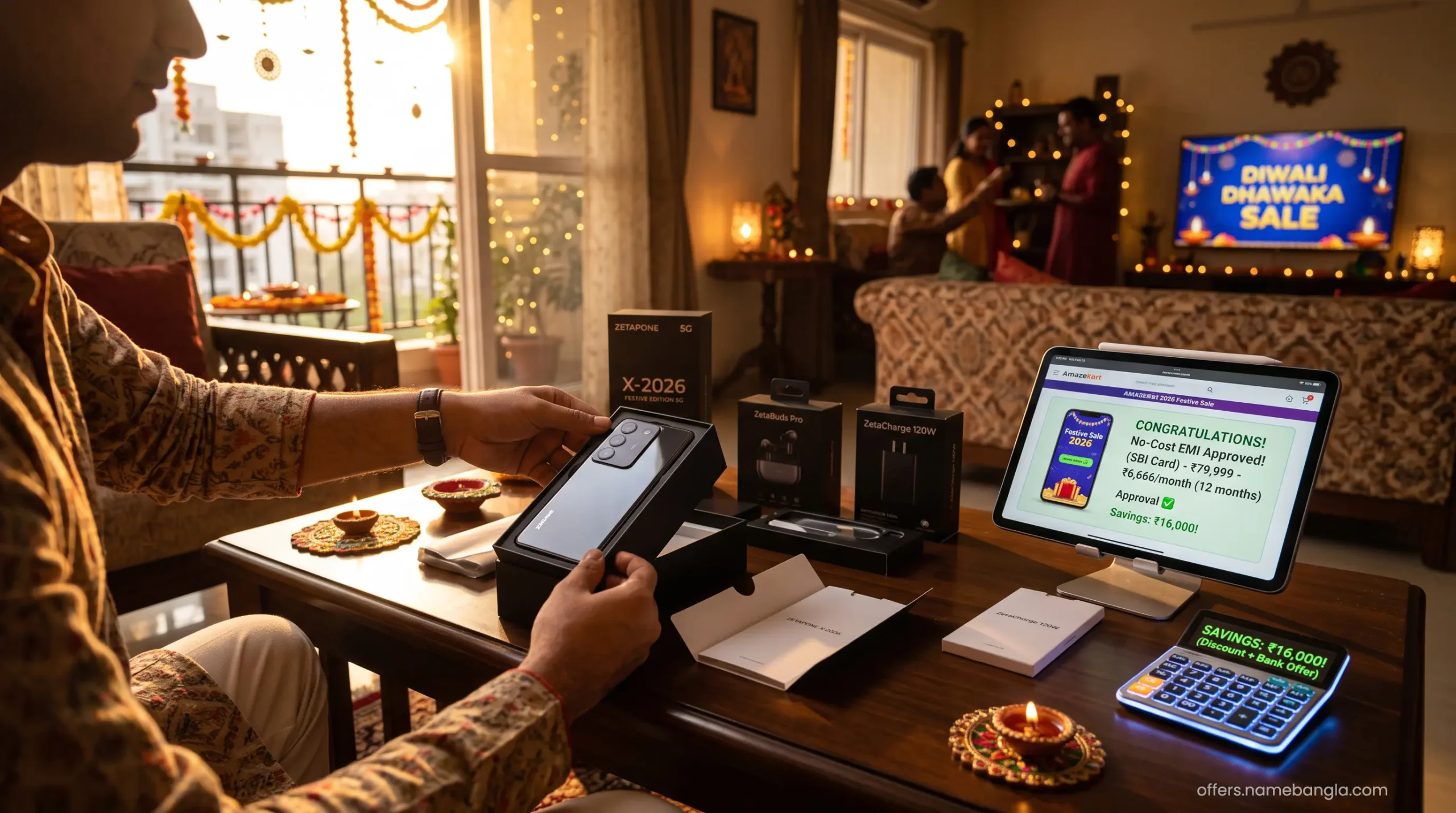
To extract the absolute maximum value from high-end mobile acquisitions, I recommend the “EMI Pre-Closure Arbitrage” technique. During the peak hours of Flipkart Big Billion Days or Amazon Great Indian Festival, initiate your flagship smartphone purchase using a 6-month or 9-month No-Cost EMI on a premium credit card (like SBI Cashback). The platform will instantly grant you the massive upfront interest subvention discount, dropping the principal hardware cost significantly. Once the transaction is successfully processed and appears on your unbilled banking statement, immediately contact your credit card customer support to pre-close the EMI. You will incur a nominal foreclosure fee (typically around 3% of the outstanding principal), but you get to permanently keep the massive upfront interest discount provided by the merchant, resulting in a net saving that far exceeds standard flat bank discounts.
Evaluating High-Tier Exchange Bonuses
The final pillar of strategic mobile acquisition relies on mastering the digital trade-in ecosystem. E-commerce giants employ complex valuation algorithms to determine the worth of your legacy hardware. During standard operational months, these valuations are notoriously low, designed to maximize refurbishing profit margins. However, during the September and October mega-sales, platforms introduce artificial “Extra Exchange Bonuses” to aggressively drive consumer upgrade cycles.
This means a three-year-old mid-range smartphone that normally commands a resale value of five thousand rupees may suddenly be valued at ten thousand rupees due to a flat five thousand rupee bonus injected by the platform. To secure this maximum valuation, your legacy device must pass a stringent physical evaluation at your doorstep. Consumers must proactively prepare their trade-in units by removing localized screen protectors to prove the underlying glass is pristine, performing a complete factory reset to remove cryptographic locks, and ensuring the battery retains enough charge to power on the device for the delivery executive’s diagnostic application.
Failing any of these physical checks results in an immediate recalculation of the cart value, forcing the consumer to pay the difference via a digital payment link before the new flagship device is handed over. Careful preparation of your old hardware is just as financially critical as selecting the correct banking instrument.
Navigating Non-Banking Financial Alternative Loans
For consumers who do not possess premium traditional credit limits, non-banking financial companies (NBFCs) like Bajaj Finserv offer a highly accessible alternative. These specialized EMI network cards bypass the stringent credit limit requirements of traditional banks, offering instant zero-down-payment consumer durable loans directly at the digital checkout portal. This democratizes access to premium hardware, allowing a broader demographic to participate in E-commerce Sales.
However, leveraging NBFC financing requires strict financial discipline. While the initial transaction appears seamless and devoid of upfront interest, the penalty structures are notoriously aggressive. Missing a scheduled electronic clearing service (ECS) mandate triggers immediate bounce charges from your primary savings account, coupled with exorbitant late payment penalties from the NBFC. Furthermore, these consumer durable loans are aggressively reported to credit bureaus. Flawless repayment behavior will significantly boost your CIBIL profile, but a single default can cripple your ability to secure future vehicular or housing finance. Consumers must accurately assess their monthly cash flow before committing to high-value hardware acquisitions through alternative lending networks.
Frequently Asked Questions on Premium Smartphone Financing
Why do some credit cards not qualify for the maximum instant discount on smartphones?
Instant bank discounts during e-commerce sales are heavily reliant on specific Bank Identification Numbers (BINs). Corporate credit cards, commercial purchasing cards, and basic entry-level debit cards are frequently excluded by the algorithm, reserving the highest discounts for premium retail credit variants.
How does the upfront interest subvention work on a mobile phone No-Cost EMI?
When you select No-Cost EMI, the retail platform calculates the total interest the bank will charge over your chosen tenure and subtracts that exact amount from the phone’s invoice price immediately. You pay the bank the lowered principal plus the interest, which equals the original discounted price.
What happens if my old phone fails the physical exchange check at delivery?
If the delivery executive’s diagnostic app detects screen damage, severe dents, or a dead battery, the original exchange value and any extra exchange bonuses are instantly revoked. You will be required to pay the difference via a digital payment link to receive your new smartphone.
Can I use an SBI Cashback card to get an instant discount and cashback simultaneously?
Typically, e-commerce platforms restrict the stacking of instant bank discounts with co-branded unlimited cashback. If a flat instant discount is applied at checkout, the transaction usually becomes ineligible for the card’s native 5% unlimited cashback, though specific festive terms may occasionally allow partial stacking.
Is it financially beneficial to pre-close a gadget EMI?
Yes, it is highly beneficial if you have the liquid cash. By pre-closing a No-Cost EMI, you retain the massive upfront discount provided by the merchant while only paying a minimal foreclosure fee (usually around 3%) to the bank, resulting in significant net savings.